⚙️ Pressed Coupler
Hydraulic cold-pressing creates a permanent, high-integrity mechanical splice — no heat, no threads.
Permanent connection. Zero heat. Zero threads.
Hydraulic Precision Splicing
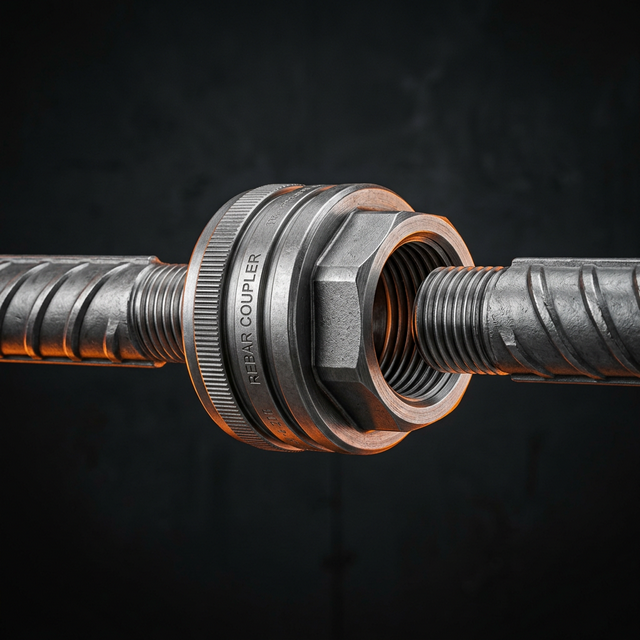
The Best Notch Pressed Coupler uses a hydraulic pressing machine to permanently deform a steel sleeve around both rebar ends. The mechanical interlock formed creates a splice that meets the full tensile capacity of the rebar with no reduction in bar area.
Because no heat is used, there is no risk of heat-affected zone (HAZ) weakening — making it ideal for environments with fire, explosive, or chemical risk classifications.
- 💪 Cold-Press Technology
- 🔥 No Heat-Affected Zone
- ⏱️ Rapid Installation
- 🏗️ Compact Profile
Key Specifications
| Bar Sizes | 12mm – 32mm |
| Material | Carbon steel sleeve |
| Compliance | BS EN 1992, ACI 318, CIRIA C641 |
| Connection Method | Hydraulic cold pressing |
| Equipment | Portable hydraulic press tool |
| Coating | Zinc epoxy anti-corrosion |
| Installation Time | < 60 seconds per joint |
| Temperature Range | -30°C to +400°C |
Pressed Coupler: Core Advantages
Cold-Press Technology
Hydraulic press permanently deforms the sleeve — no heat, no welding consumables, no skill-dependent process.
No Heat-Affected Zone
Zero thermal input means full parent metal strength is preserved at every joint.
Rapid Installation
Pre-positioned sleeves can be pressed in under 60 seconds per joint.
Compact Profile
Minimal splice diameter — ideal where tight rebar spacing prevents threaded coupler access.
Non-Destructive Test
Splice quality can be confirmed by go/no-go gauge without destructive sampling.
Global Standards
Complies with ISO, BS, ACI, and Gulf Authority approvals.
How It Works — Step by Step
A streamlined, verifiable installation process designed for speed, safety, and consistent quality on every project.
Sleeve Placement
Thread the steel sleeve over one rebar end to half-sleeve depth.
Positioning
Insert the opposing rebar end until both bars meet centrally inside the sleeve.
Hydraulic Press
Apply the purpose-built hydraulic pressing tool at marked press positions on the sleeve.
Verification
Use the go/no-go gauge to confirm each press point meets the required deformation profile.
Mark & Record
Mark the completed joint with QA tag and log in site records.
Where It's Used — Global Projects
Confined Spaces
Perfect where threading access is physically impossible — tunnels, piled foundations, transfer slabs.
Electrical Substations
Preferred where zero-spark processes are mandated (hydraulic = no ignition risk).
Precast Connections
Used to connect precast elements where permanent, tamper-proof joints are required.
Underwater Structures
Hydraulic tools can be adapted for submerged pressing operations in marine projects.
Frequently Asked Questions
Yes. Hydraulic press tools are calibrated at regular intervals (typically every 6 months) with documentation provided. Best Notch supplies calibrated tools and inspection records.
Yes. A go/no-go dimensional gauge confirms the deformation profile at each press point without any destructive sampling.
Bar ends should be clean and free of scale. A quick wire-brush clean is typically sufficient. No machining or threading is required.
For straight-bar applications only. If bends are required near the splice, consult our engineering team for position guidance.
Unpressed sleeves can be stored indefinitely when kept dry. The lacquer coating protects against corrosion during typical construction storage periods.
Can't find it here? Our engineering team is available 24/7.
Ask Our Engineers →How many joints do you need?
Move the slider to get an indicative time saving versus traditional rebar lapping.