🔩 Parallel Threading Coupler
The industry-standard mechanical splice for maximum load transfer and seismic performance.
Zero cross-section loss. 100% tensile transfer.
Maximum Strength & Integrity
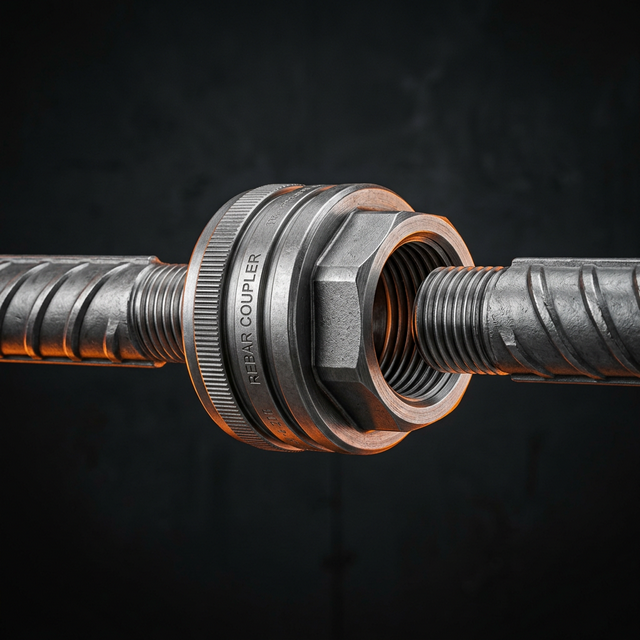
The Best Notch Parallel Threading Coupler is our flagship mechanical splicing solution. Engineered to exceed the ultimate tensile strength of the parent rebar, this system guarantees bar failure always occurs outside the joint — never at the splice.
The process involves cold forging rebar ends to increase their diameter before threading. This ensures there is no reduction in cross-sectional area, delivering 100% load transfer with zero material waste.
- 🔩 Full Tensile Transfer
- 🌀 Cold Forged Ends
- ⚡ Seismic Approved
- 🏗️ No Lap Wastage
Key Specifications
| Bar Sizes | 12mm – 40mm (up to 57mm on request) |
| Material | High-yield carbon steel / Alloy steel |
| Compliance | BS 8110, ACI 318, IBC, DIN 1045, ISO 15630 |
| Tensile Strength | > 100% of specified rebar strength |
| Coating | Epoxy / Zinc galvanised options |
| Installation Time | < 3 minutes per joint |
| Thread Type | Parallel (non-tapered) |
| Temperature Range | -20°C to +500°C |
Parallel Threading Coupler: Core Advantages
Full Tensile Transfer
Exceeds 125% of rebar yield strength — meets Type 2 classification under ACI 318 and BS 8110.
Cold Forged Ends
Upsetting process enlarges bar diameter before threading — zero cross-section loss at the threaded zone.
Seismic Approved
Excellent fatigue and cyclic load performance — ideal for earthquake-resistant structures.
No Lap Wastage
Eliminates steel overlap — reduces total rebar tonnage by up to 30% on large projects.
Tool-Free Speed
Simple hand-and-wrench assembly. No special equipment needed on site.
Wide Size Range
Covers 12mm to 40mm rebar — all common structural grades.
How It Works — Step by Step
A streamlined, verifiable installation process designed for speed, safety, and consistent quality on every project.
End Preparation
Rebar ends are cold-forged (upset) to increase diameter before threading begins.
Thread Cutting
Precision CNC machine cuts parallel threads onto the upset rebar ends.
Coupler Installation
Thread the coupler onto one bar end until half-thread engagement is reached.
Joint Assembly
Insert the opposing rebar — tighten with torque wrench to specified value.
Inspection & Mark
Visual thread check and torque marking applied as per project QA plan.
Where It's Used — Global Projects
High-Rise Buildings
Used on core walls, transfer plates, and seismic frames in towers above 20 storeys.
Bridge Decks & Piers
Standard on precast bridge beams and pile cap connections worldwide.
Industrial Structures
Preferred in heavy-load industrial floors, machine foundations, and bunkers.
Marine Structures
Epoxy-coated variants used in jetties, breakwaters, and offshore platforms.
Frequently Asked Questions
Parallel threading maintains a consistent thread profile along its length, requiring no thread engagement torque variation. Tapered threads self-lock as they tighten. Our parallel system delivers more predictable, verifiable clamping with torque wrench confirmation.
Yes. Parallel threading couplers meet the cyclic load and fatigue requirements for seismic design as defined in ACI 318 Appendix D and IBC. They are classified as Type 2 mechanical splices.
No. The threading equipment is used off-site or in a centralized fabrication zone. On site, only a standard torque wrench is required.
An experienced operative can complete one joint in under 3 minutes, significantly faster than lapping or welding.
Compatible with BS 500B, ASTM A615 Gr 60/75, DIN B500B, and other high-yield reinforcement grades.
Can't find it here? Our engineering team is available 24/7.
Ask Our Engineers →How many joints do you need?
Move the slider to get an indicative time saving versus traditional rebar lapping.